Confidence, compliance and commercial readiness
The transition from early development into commercialisation in regulated life science industries requires more than technical success. Scientific performance alone does not guarantee product approval, market access, or sustained supply capability. Regulatory authorities, partners, and internal governance structures all require demonstrable assurance that processes are controlled, data is reliable, and manufacturing systems are capable of consistently producing material that meets predefined specifications.
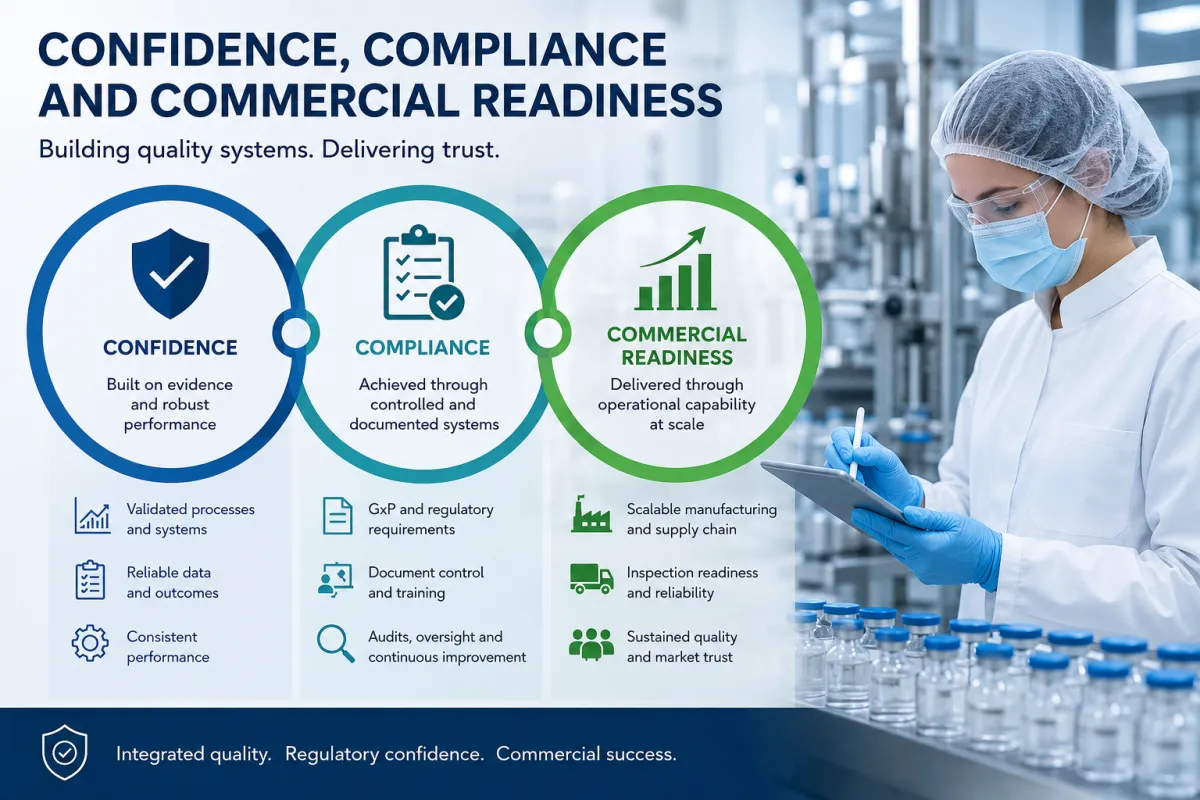
Confidence, compliance, and commercial readiness are therefore interdependent concepts. Confidence reflects the level of assurance that systems and processes will perform as intended. Compliance reflects adherence to applicable regulatory requirements such as GMP, GLP, and GCP. Commercial readiness reflects the organisation’s ability to operate at scale under routine conditions without compromising quality or regulatory obligations.
These three elements develop progressively and must be intentionally aligned as organisations mature.
Confidence as a Function of System Maturity
Confidence in regulated environments is not subjective; it is built through evidence. This evidence arises from validated processes, consistent performance data, controlled documentation, and demonstrated ability to manage deviation and change effectively.
In early development stages, confidence is often limited to experimental reproducibility and technical feasibility. As processes become more defined, confidence expands through qualification and validation activities that demonstrate consistent performance under controlled conditions.
Process validation provides structured evidence that manufacturing processes operate within defined parameters and produce expected outcomes. Analytical validation ensures that test methods are suitable for their intended purpose and generate reliable results. Equipment qualification confirms that systems operate correctly under defined conditions.
Confidence increases as variability decreases and process understanding improves. However, confidence is only meaningful when it is supported by traceable data and documented evidence that can withstand regulatory scrutiny.
Compliance as a Structured Control System
Compliance represents the formalised application of regulatory requirements across all relevant operational activities. It is implemented through quality management systems that define how work is performed, recorded, reviewed, and approved.
Regulatory frameworks such as Good Manufacturing Practice, Good Laboratory Practice, and Good Clinical Practice establish baseline expectations for documentation, validation, training, data integrity, and operational control. Compliance is not achieved through isolated procedures but through an integrated system of interdependent controls.
Document control ensures that only current and approved procedures are in use. Training systems ensure that personnel are qualified to perform assigned tasks. Deviation and investigation systems ensure that unexpected events are documented, assessed, and resolved. Change control systems ensure that modifications are evaluated before implementation to determine potential impact on product quality and regulatory compliance.
Electronic systems used in regulated environments must be validated to ensure they function as intended. Audit trails, access controls, and data integrity safeguards are essential components of compliant systems.
Compliance also requires ongoing oversight through internal audits, management review, and continuous improvement processes. These mechanisms ensure that the quality system remains effective as organisational complexity increases.
Commercial Readiness as Operational Capability
Commercial readiness extends beyond regulatory compliance and scientific confidence. It reflects the organisation’s ability to operate at scale, maintain supply continuity, and meet market demand under routine conditions.
Manufacturing scalability is a key component of commercial readiness. Processes must be robust enough to maintain consistent output across multiple production cycles. Supply chains must be qualified and capable of delivering materials within defined specifications and timelines.
Quality systems must be able to handle increased volumes of data, deviations, and change requests without loss of control or traceability. This requires scalable documentation systems, efficient workflow management, and effective resource allocation.
Commercial readiness also includes inspection preparedness. Organisations must be able to demonstrate at any time that their systems are compliant, their data is reliable, and their manufacturing processes are under control.
Importantly, commercial readiness is not achieved at a single point in time. It is the result of cumulative development across technical, quality, and operational domains.
Interdependence of the Three Domains
Confidence, compliance, and commercial readiness are closely interconnected. High confidence in process performance supports compliance by reducing variability and increasing predictability. Strong compliance systems generate the evidence required to demonstrate confidence to regulators and stakeholders. Commercial readiness depends on both, as market supply requires stable processes and compliant operations.
Weakness in any one domain affects the others. For example, insufficient process validation reduces confidence and increases regulatory risk, which in turn delays commercial deployment. Poor compliance systems undermine data integrity, reducing both regulatory acceptance and operational stability. Lack of commercial readiness can expose gaps in scalability that compromise both confidence and compliance when demand increases.
Effective lifecycle management requires that all three domains are developed in parallel rather than sequentially.
Building Confidence Through Controlled Development
Confidence is strengthened through structured development practices that emphasise reproducibility and control. Early-stage research must transition into defined processes supported by controlled documentation and validated methods.
Risk-based approaches are essential. Not all processes require the same level of control at every stage, but critical quality attributes must be identified and monitored throughout development. This ensures that resources are focused on areas that have the greatest impact on product quality and patient safety.
Process characterisation studies provide insight into variability and performance boundaries. These studies form the foundation for later validation activities and support regulatory submissions.
As understanding increases, confidence becomes less dependent on individual experimental outcomes and more reliant on established process capability.
Embedding Compliance Without Overburdening Operations
Effective compliance systems must be proportionate to organisational maturity and operational complexity. Overly complex systems introduced too early can hinder innovation and reduce efficiency, while underdeveloped systems increase regulatory risk.
A structured quality management system provides the framework for embedding compliance into daily operations. This includes standardised procedures, defined roles and responsibilities, controlled documentation systems, and clear escalation pathways for quality issues.
Training plays a critical role in ensuring compliance is consistently applied. Personnel must understand not only procedural requirements but also the rationale behind them. This supports consistent decision making in situations that are not explicitly defined in procedures.
Compliance should be viewed as an operational discipline embedded within scientific and manufacturing activities rather than a separate administrative layer.
Establishing Commercial Readiness Through System Integration
Commercial readiness requires integration of multiple functional areas including manufacturing, quality assurance, supply chain management, and regulatory affairs. These functions must operate in a coordinated manner to ensure consistent product availability and regulatory compliance.
Technology transfer processes are central to commercial readiness. Knowledge generated during development must be accurately transferred into manufacturing environments without loss of critical information. This includes process parameters, analytical methods, control strategies, and validation data.
Supply chain qualification ensures that external providers meet defined quality standards and can reliably support production requirements. This includes raw material suppliers, contract manufacturers, and testing laboratories.
Capacity planning ensures that production systems can meet forecast demand without compromising quality or compliance. This requires alignment between operational planning and quality system capability.
Managing Transition Between Development Stages
Transition from development to commercial operation represents a critical risk period. Systems that function effectively at small scale may not be adequate for routine commercial production.
During transition, validation activities must be completed to demonstrate process consistency. Documentation systems must be finalised and fully controlled. Training must be completed and verified for all personnel involved in commercial operations.
Regulatory submissions often depend on the completeness and robustness of these transition activities. Gaps in evidence or system readiness can delay approval or restrict market access.
Structured planning and phased implementation reduce the risk associated with this transition by ensuring that each component of commercial readiness is addressed systematically.
Conclusion
Confidence, compliance, and commercial readiness represent three interdependent pillars of successful regulated product development and manufacturing. Confidence is built through controlled scientific development and validated processes. Compliance is maintained through structured quality systems aligned with regulatory expectations. Commercial readiness is achieved through integrated operational capability that supports sustained supply and market performance.
Organisations that develop these elements in alignment are better positioned to progress smoothly from research to commercialisation. The strength of each domain reinforces the others, creating a stable foundation for regulatory approval, operational consistency, and long-term success in highly regulated environments.
