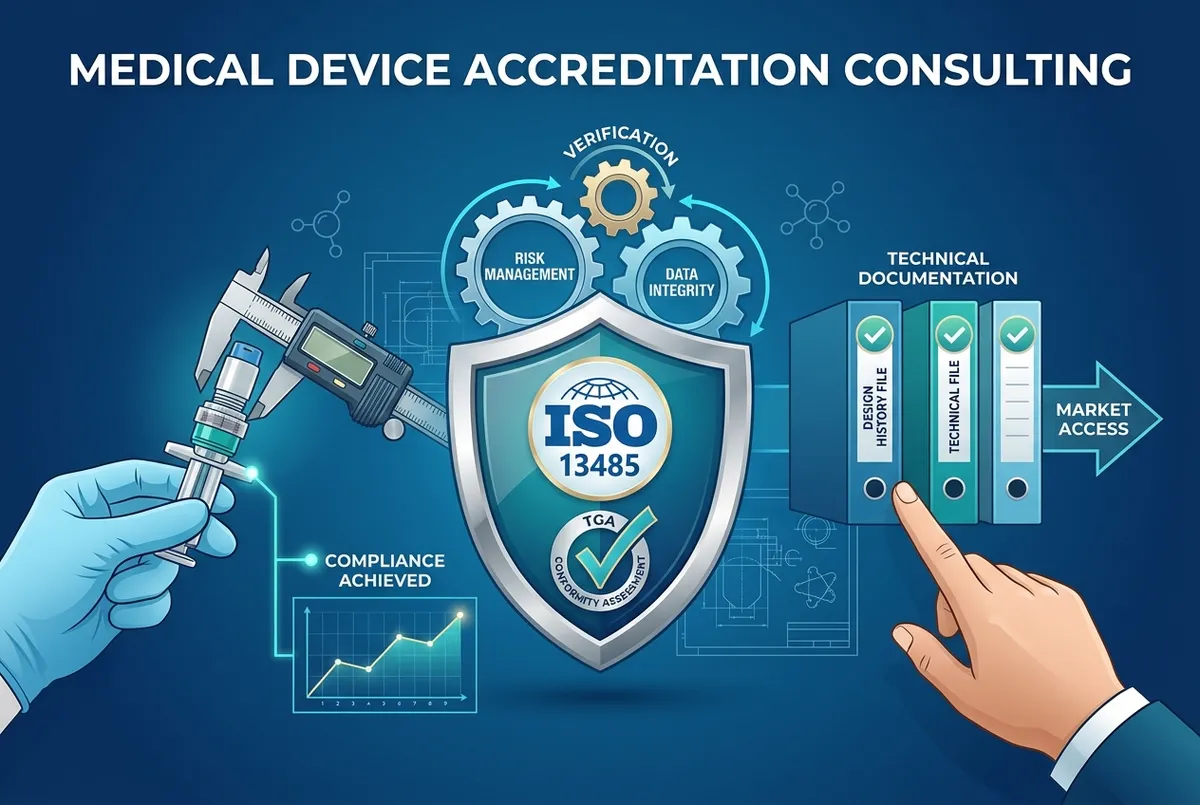
Medical Device Accreditation Consulting
The path to commercializing a medical device requires strict compliance with international consensus standards and localized statutory regulations. Within the Australian therapeutic goods ecosystem, manufacturers, innovators, and distributors must satisfy the rigorous conformity assessment pathways enforced by the Therapeutic Goods Administration (TGA). Central to this regulatory mandate is the architecture, deployment, and systemic maintenance of a comprehensive Quality Management System (QMS) that satisfies the criteria of ISO 13485. Achieving this level of accreditation demands an objective, scientific approach to engineering, verification, and risk management rather than relying on superficial administrative checklists.
Schedule A Free Consultation Now
True operational excellence is achieved when an organization establishes native, internal capability to manage its regulatory destiny. Relying permanently on transactional, external entities to manage compliance functions introduces profound vulnerability during regulatory audits, post-market surveillance cycles, and product lifecycles. Systemic integration of compliance standards must occur directly within the everyday design, engineering, and manufacturing workflows of the technical workforce, transforming regulatory hurdles into repeatable internal protocols.
The Architecture of ISO 13485 System Design
Implementing an audit-ready quality management system under the ISO 13485 standard requires a deep evaluation of an organization's existing operational characteristics. Medical devices vary significantly in complexity, ranging from simple software-as-a-medical-device (SaMD) diagnostic applications to complex implantable electronic assemblies. Consequently, a lean, fit-for-purpose QMS must be deliberately scaled to match the precise risk classification and manufacturing realities of the specific hardware or software platform.
Quality Systems Now establishes this foundational framework by translating abstract regulatory clauses into concrete, localized engineering procedures. This structural alignment covers the entire product lifecycle, governing document control architecture, human resource competency matrices, facility environmental controls, and supplier qualification protocols. Rather than imposing unnecessary administrative friction that paralyzes early-stage engineering teams, the focus centers on embedding lean quality gates that ensure complete compliance while actively accelerating technical development loops. The ultimate objective is to deliver a highly optimized system that transitions effortlessly from development environments into validated commercial production pipelines.
Rigorous Design Controls and Risk Management
The core of medical device accreditation rests upon the empirical integration of design controls and systemic risk management workflows, as mandated by ISO 14971. Regulatory authorities scrutinize the connection between design inputs, engineering outputs, verification methodologies, and final validation testing. Gaps within the Design History File (DHF) represent the most frequent point of failure during TGA conformity assessments and international notified body reviews.
To insulate organizations from these expensive re-engineering cycles, Quality Systems Now introduces rigorous, data-driven risk management protocols directly into the early design phase. This scientific approach requires executing failure mode and effects analysis (FMEA) down to the component level, establishing clear traceability between identified hazards, mitigation strategies, and physical verification data. By building this complete traceability matrix in-house, engineering teams possess the objective evidence necessary to demonstrate that the device meets all relevant Essential Principles of safety and performance. This continuous data integrity forms the baseline for compilation of the technical documentation required for global market access.
Advanced Computerized Systems and Validation Engineering
Modern medical device manufacturing plants and analytical laboratories depend heavily on automated production equipment, enterprise resource planning software, and complex laboratory information management systems. The validation of these computerized installations represents a critical component of medical device accreditation. Under modern regulatory frameworks, any software tool utilized within the quality system or production lifecycle must undergo formal verification to guarantee complete data integrity, secure audit trail functionality, and strict electronic record alignment with ALCOA+ principles.
Quality Systems Now provides the specialized technical engineering oversight necessary to execute lifecycle validation strategies across these complex environments. This process involves authoring comprehensive validation master plans, constructing detailed user requirement specifications, and executing installation, operational, and performance qualification protocols (IQ/OQ/PQ). By instilling these precise validation engineering practices directly within the internal team, testing laboratories and biotechnology companies ensure that their cleanrooms, automated inspection systems, and analytical instrumentation remain in a constant state of validated control, ready to withstand intense physical inspection by regulatory auditors.
Root Cause Analysis and Audit Readiness Protocols
When engineering anomalies, out-of-specification test results, or manufacturing deviations manifest, a compliant organization must deploy immediate, structured investigative workflows. Regulatory investigators routinely evaluate the scientific depth of a company's deviation files to gauge the authentic maturity of its quality culture. Superficial investigations that conclude human error as the root cause are universally flagged as significant non-compliances.
Quality Systems Now embeds disciplined, structured Root Cause Analysis (RCA) techniques—such as Ishikawa diagrams, fault tree analysis, and the five-whys methodology—directly into the quality engineering department. This analytical transformation shifts the internal focus toward identifying and permanently correcting underlying process and design flaws. Once the true root cause is isolated, targeted Corrective and Preventive Actions (CAPA) are designed, executed, and statistically verified for long-term efficacy. Furthermore, this deep preparedness is reinforced through mock regulatory audits and rigorous internal audit schedules, ensuring the internal workforce handles actual TGA inspections with total technical confidence and transparency.
Building Sustainable In-House Independence
The long-term commercial success of an Australian medical device innovator relies entirely on its ability to sustain compliance independently. A truly effective quality consultancy must design a pathway toward complete self-sufficiency rather than creating a business model based on permanent external dependence. The value of external expertise lies in its capability to serve as a high-velocity catalyst for internal workforce evolution, upskilling employees until regulatory fluency is fully internalized.
Through customized technical workshops, direct hands-on execution of validation projects, and systematic quality assurance mentorship, Quality Systems Now progressively transfers deep regulatory knowledge straight to your internal staff. As the in-house team gains technical mastery over cGMP expectations, ISO 13485 structures, and technical documentation requirements, absolute ownership of the quality management system transitions naturally back inside the company. This strategic transformation guarantees that therapeutic goods manufacturers, biotechnology firms, and medical device organizations retain total, native control over their compliance destiny, safeguarding patient safety while driving profitable global scale.
