
Outsourced quality assurance pharma in Australia
The pharmaceutical, biotechnology, and medical device manufacturing sectors in Australia operate within one of the most stringent regulatory environments globally. Orchestrated by the Therapeutic Goods Administration (TGA), the regulatory framework demands unwavering adherence to current Good Manufacturing Practice (cGMP) standards. For many organizations, particularly emerging biotechnology entities, clinical-stage trial sponsors, and expanding manufacturing facilities, maintaining a fully staffed, permanent in-house quality assurance (QA) department can present significant operational and financial challenges. Consequently, strategic integration of outsourced quality assurance expertise has emerged as a reliable mechanism to achieve regulatory compliance while systematically developing internal technical maturity.
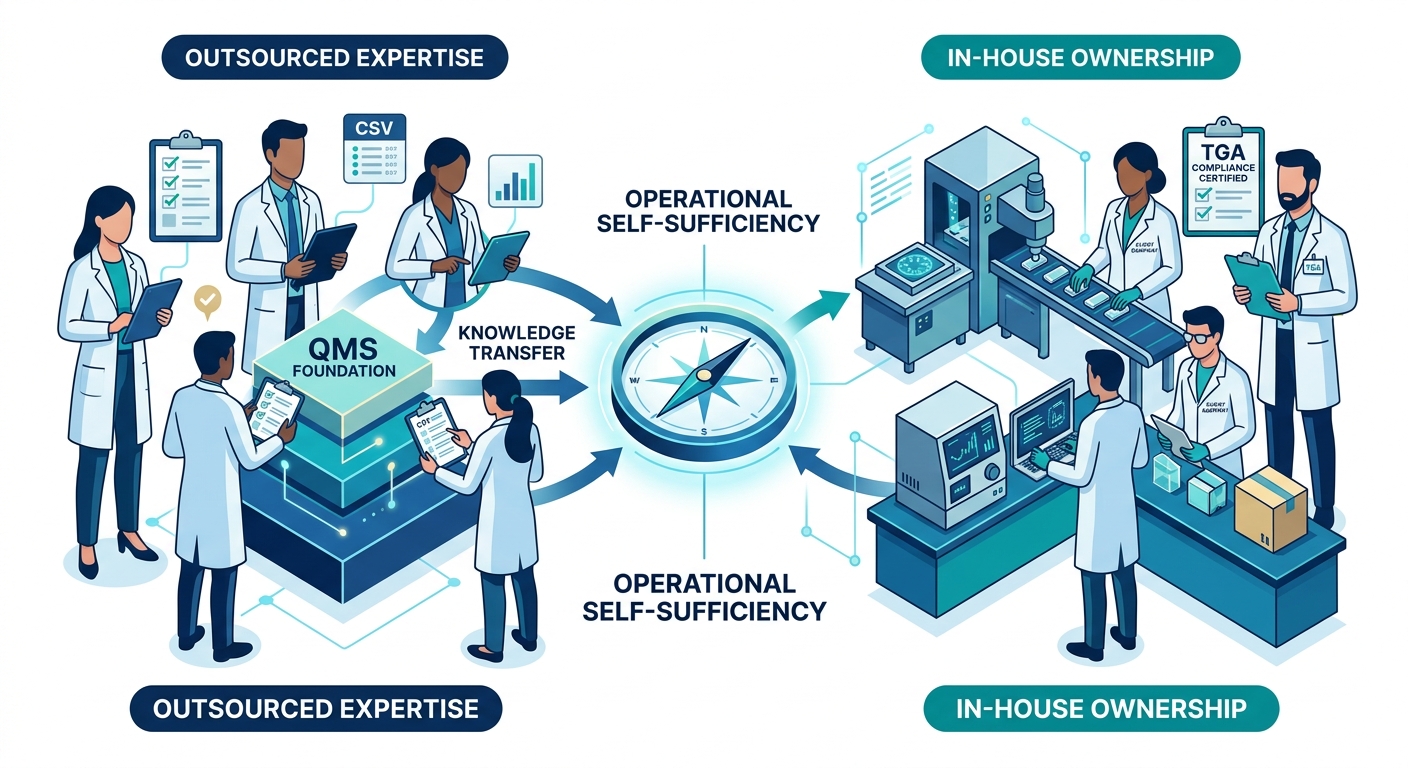
Outsourcing QA functions involves much more than contracting temporary administrative oversight. It requires deploying specialized scientific knowledge and regulatory expertise to architect, refine, and maintain operational systems. This technical approach guarantees that quality management systems (QMS) remain compliant with the therapeutic goods legislation while remaining agile enough to support rapid product development and clinical progression.
Strategic Allocation of Specialized Regulatory Expertise
Pharmaceutical manufacturing pipelines require complex oversight spanning document control, validation protocols, facility environmental monitoring, and materials management. Startups and mid-sized enterprises often face a choice between hiring generalist internal personnel or accessing a diverse pool of deep subject matter specialists through a strategic outsourcing model. Transitioning to external technical specialists grants immediate access to individuals who possess deep, current knowledge of specific regulatory domains, including sterile product manufacturing, advanced therapeutic medicinal products (ATMPs), computerized system validation, and complex analytical chemistry methodology.
This targeted approach prevents the common operational bottleneck where critical validation exercises or batch release workflows stall due to a lack of specialized internal knowledge. Quality Systems Now brings extensive experience derived from participating in numerous TGA audits, facility commissioning projects, and regulatory submissions. These cross-industry insights allow the deployment of highly efficient quality systems that avoid common compliance errors. By integrating Quality Systems Now expert resources, companies quickly bridge the gap between early-stage development flexibility and the strict regulatory frameworks demanded by commercial production regimes.
Structural Design of a Compliant Quality Management System
The foundation of any compliant pharmaceutical operation is a robust, data-driven Quality Management System. Under Australian regulations, a QMS must systematically govern all variables affecting product quality, safety, and efficacy. As GxP and regulatory compliance specialists, Quality Systems Now evaluates existing operational architectures to identify compliance gaps, structural bottlenecks, and data integrity vulnerabilities. Through targeted remediation, comprehensive procedural frameworks are designed and implemented to satisfy both national TGA mandates and international alignment standards, such as those defined by the Pharmaceutical Inspection Co-operation Scheme (PIC/S).
A well-architected QMS provides clear mechanisms for document control, personnel training matrices, supplier qualification, change control, and deviation management. Rather than introducing overly bureaucratic or rigid workflows that hinder research and operational agility, Quality Systems Now focuses on designing lean, fit-for-purpose quality systems. This methodology ensures that quality controls scale naturally alongside the organization's growth. The primary objective is always to transition the initial external framework into a permanent internal asset, establishing clear organizational ownership over every quality metric.
Mitigating Risk via Data Integrity and Validation
Modern pharmaceutical manufacturing relies heavily on automated production systems, computerized laboratory instrumentation, and electronic record-keeping. The TGA places immense scrutiny on data integrity, requiring all regulated information to follow the ALCOA+ principles—meaning records must be attributable, legible, contemporaneous, original, accurate, complete, consistent, enduring, and available. Achieving this standard requires technical knowledge of computerized systems validation (CSV) and software engineering principles.
Quality Systems Now provides the specialized technical oversight necessary to execute lifecycle validation strategies for critical equipment, cleanrooms, and computerized systems. This work includes drafting User Requirement Specifications (URS), executing Installation, Operational, and Performance Qualifications (IQ/OQ/PQ), and compiling comprehensive validation summary reports. Furthermore, these specialists establish robust audit trail review methodologies and access control protocols. By building these rigorous validation frameworks, Quality Systems Now ensures that the underlying data supporting product specifications and regulatory filings can withstand intense regulatory scrutiny.
Root Cause Analysis and Auditing Competency
When process deviations, out-of-specification (OOS) analytical results, or environmental monitoring excursions occur, the manufacturing organization must respond with immediate, scientifically sound investigation protocols. A common point of failure during regulatory inspections is an inability to properly investigate anomalies. Quality Systems Now introduces structured Root Cause Analysis (RCA) methodologies, such as fishbone diagrams, failure mode and effects analysis (FMEA), and the five-whys technique. This disciplined analytical approach shifts focus away from superficial human-error explanations toward identifying systemic process and equipment failures.
Following the identification of a true root cause, targeted Corrective and Preventive Actions (CAPA) are formulated. These CAPA frameworks modify the underlying process mechanics to permanently eliminate the vulnerability. Additionally, Quality Systems Now plays a pivotal role in executing mandatory independent internal audits and third-party vendor audits. Routine, rigorous auditing ensures that suppliers, contract manufacturing organizations (CMOs), and contract research organizations (CROs) consistently meet the required quality baselines, shielding the primary sponsor from vicarious regulatory liability.
Cultivating Long-Term In-House Capacity
The ultimate value of partnering with Quality Systems Now lies in the structured capacity building engineered to render continuous outsourcing obsolete. A sustainable quality strategy does not create a permanent dependence on external contractors; instead, it uses GxP specialists as catalysts for internal workforce transformation. Through systematic mentorship, customized technical training workshops, and hands-on operational collaboration, Quality Systems Now progressively transfers vital regulatory and scientific knowledge directly into the client’s internal workforce.
As the internal staff gains technical confidence and operational familiarity with cGMP requirements, ownership of the QMS shifts smoothly back inside the organization. This strategic evolution ensures that therapeutic goods manufacturers, testing laboratories, and biotechnology companies retain deep, native control over their compliance destiny. By blending immediate external technical support with an explicit focus on internal capacity building, Quality Systems Now establishes the robust quality cultures required to protect patient safety and scale operations securely in the global marketplace.
