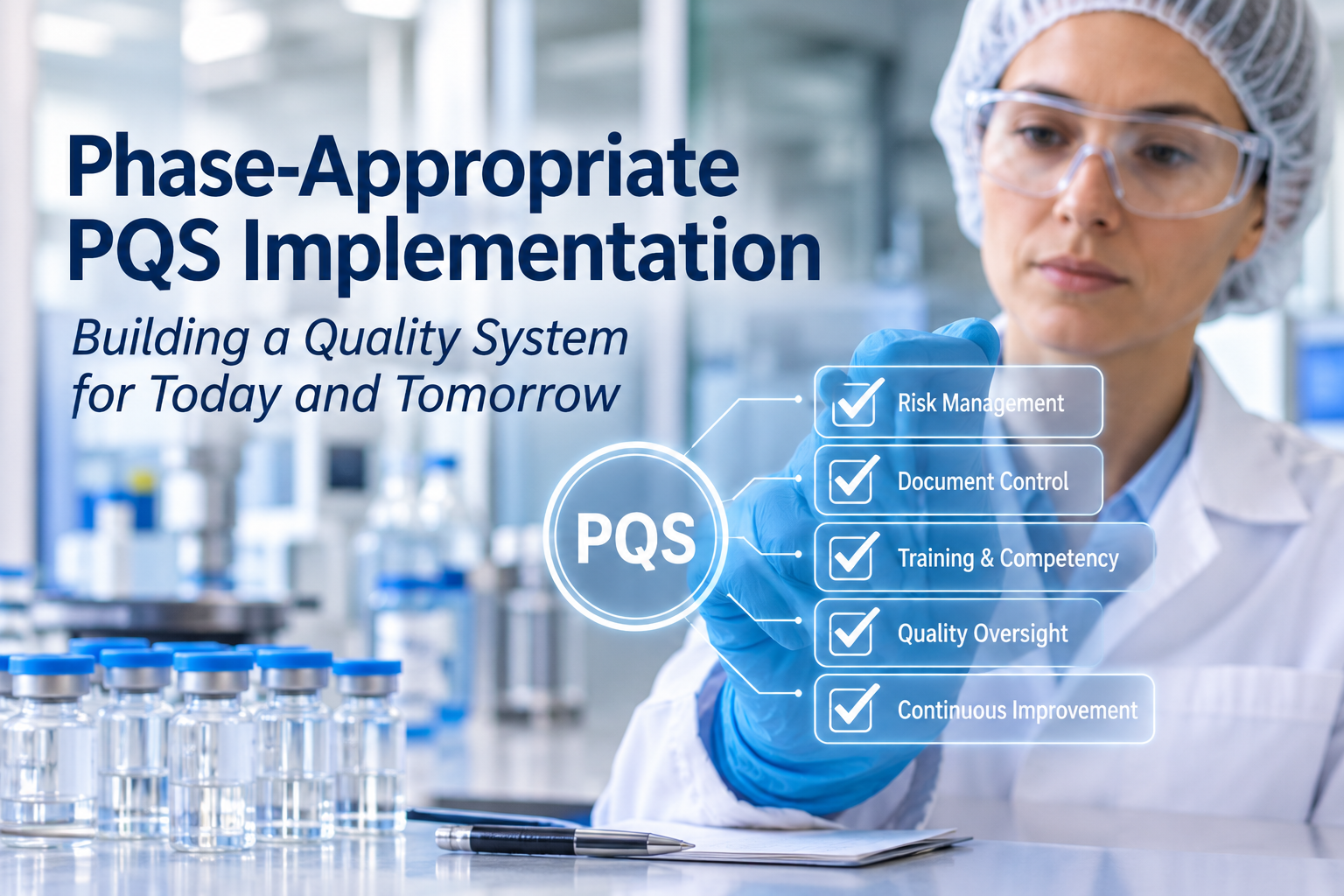
Phase-Appropriate PQS Implementation
A Pharmaceutical Quality System (PQS) provides the organisational framework, processes and controls required to ensure that medicinal products are consistently manufactured, tested and supplied in accordance with applicable quality and regulatory requirements. An effective PQS supports product quality, patient safety, data integrity and regulatory compliance throughout the product lifecycle.
However, implementing a PQS is not a uniform exercise. The quality systems required by an early-stage biotechnology company will differ in complexity and operational scope from those required by an established therapeutic goods manufacturer operating multiple manufacturing facilities. Similarly, a testing laboratory, medical device manufacturer or contract service provider will have quality obligations that reflect its activities, products, processes and regulatory environment.
Phase-appropriate PQS implementation recognises these differences. It establishes a quality framework that is proportionate to an organisation’s activities, development stage, operational complexity and risk profile, while maintaining the controls necessary to meet applicable regulatory requirements. The objective is not to create the largest possible quality system, but to develop one that is scientifically justified, effective, sustainable and capable of evolving as the organisation grows.
Understanding the Pharmaceutical Quality System
The PQS concept is well established within international pharmaceutical quality guidance, particularly ICH Q10, Pharmaceutical Quality System. It provides a model for managing quality across the product lifecycle, from pharmaceutical development and technology transfer through commercial manufacturing and product discontinuation.
A PQS integrates management responsibilities, documented procedures, operational controls, quality oversight and continual improvement. Rather than treating compliance as a collection of independent documents, it connects quality-related activities into a coordinated management system.
Core elements generally include:
Quality policy and defined management responsibilities.
Document and record control.
Personnel training and qualification.
Deviation and nonconformance management.
Corrective and preventive action (CAPA).
Change control.
Risk management.
Supplier and materials management.
Equipment, facility and process controls.
Validation and qualification.
Laboratory and analytical controls.
Product quality review and performance monitoring.
Internal audits and management review.
Complaint handling, product quality defects and recalls, where applicable.
The specific structure and depth of these elements depend on the organisation’s activities. A company developing a product in early-stage research may not yet require the same operational procedures as a facility conducting routine commercial manufacture. Nevertheless, it should establish appropriate controls before activities become sufficiently complex that informal practices create unacceptable risks.
What Does Phase-Appropriate Implementation Mean?
Phase-appropriate implementation involves establishing quality controls that are suitable for the organisation’s current stage of development and intended activities, with sufficient flexibility to accommodate future requirements.
It does not mean that regulatory obligations can be postponed or selectively applied. Applicable GMP, ISO and other regulatory requirements must be met whenever they apply to the activity being performed. Instead, phase appropriateness concerns how the organisation designs, documents, implements and maintains its quality arrangements within those obligations.
For example, an early-stage biotechnology company conducting non-clinical research may need controlled laboratory procedures, equipment maintenance arrangements, training records and reliable data management. If the company progresses towards clinical manufacturing, additional controls may be required for batch documentation, material traceability, manufacturing operations, validation, quality oversight and product release.
The system should therefore develop alongside the organisation. Its procedures, responsibilities and oversight mechanisms must reflect the actual risks and regulatory status of its operations.
A phase-appropriate approach also avoids unnecessary administrative complexity. Excessive documentation, poorly designed approval processes and procedures that do not reflect actual working practices can make a quality system difficult to operate. Effective implementation prioritises controls that protect product quality, patient safety and data reliability.
Establishing the Organisation’s Quality and Regulatory Context
The first step in PQS implementation is understanding the organisation’s activities and regulatory obligations.
This requires an assessment of the products being developed or manufactured, the processes being performed, the markets being supplied and the standards or regulations that apply. Relevant considerations may include therapeutic goods legislation, GMP requirements, ISO standards, laboratory accreditation requirements and obligations relating to clinical or non-clinical activities.
The assessment should establish whether the organisation is conducting research, development, testing, manufacturing, packaging, storage, distribution or a combination of these activities. It should also identify outsourced operations and the quality responsibilities retained by the organisation.
This distinction is important because outsourcing an activity does not necessarily transfer all associated quality responsibilities. Organisations must maintain appropriate oversight of external service providers, including the assessment and monitoring of suppliers and contract organisations according to the risks and criticality of the services provided.
A regulatory and operational assessment provides the foundation for defining the PQS scope. Without this initial understanding, companies may implement procedures that are irrelevant to their activities while overlooking controls that are essential to compliance.
Designing the PQS Around Risk
Quality risk management is central to phase-appropriate implementation. ICH Q9(R1) provides guidance on applying risk management principles to pharmaceutical quality, supporting decisions that are proportionate to the potential impact on product quality and patient safety.
Risk assessment should consider the nature of each activity, the likelihood of failure, the potential consequences and the ability of existing controls to detect or prevent problems.
For example, a procedure governing the handling of critical raw materials may require more stringent controls than an administrative process with no direct influence on product quality. Similarly, an analytical method used to determine product potency requires appropriate scientific justification, qualification or validation according to its intended use and applicable requirements.
Risk-based decisions should be documented sufficiently to explain the rationale, assumptions and resulting controls. They should also be reviewed when new information becomes available or when changes to processes, facilities, equipment or products alter the original risk profile.
Risk management is not a mechanism for reducing mandatory requirements. It is a structured method for determining how quality controls should be designed and prioritised while maintaining compliance.
Implementing a PQS in Early-Stage Organisations
Early-stage companies often operate with small teams, limited infrastructure and evolving processes. Their quality systems need to provide clear responsibilities and reliable controls without imposing administrative arrangements that are disproportionate to their operations.
At this stage, priority should be given to establishing the fundamental elements of quality management. These commonly include document control, record management, training, equipment oversight, deviation reporting, change management and appropriate data integrity controls.
Responsibilities should be clearly assigned, even where several quality-related functions are performed by the same individual. Management must understand its accountability for quality, and personnel must know which procedures apply to their activities.
Procedures should reflect actual operations rather than describe processes that exist only on paper. Records must provide sufficient evidence that activities were performed as required, by appropriately trained personnel, and that relevant results and decisions can be reconstructed.
Early implementation should also consider future development. For example, a company anticipating clinical manufacturing should avoid establishing informal material identification or recordkeeping practices that will be difficult to replace later. Building sound quality habits early can reduce the effort required when regulatory expectations and operational complexity increase.
Scaling the PQS During Development and Technology Transfer
As organisations progress from research into development, clinical activities or manufacturing, their quality systems must become more structured.
Development activities may introduce additional requirements for process characterisation, analytical method development, material control, equipment qualification and technology transfer. The extent of these controls depends on the activity, product and applicable regulatory framework.
Technology transfer is a particularly important stage because knowledge and process responsibilities move between development teams, manufacturing sites or external partners. Inadequate transfer arrangements can result in inconsistent processes, incomplete documentation and uncertainty about critical quality attributes or process parameters.
A suitable PQS should define how transfer activities are planned, documented, reviewed and approved. Relevant information may include process descriptions, analytical methods, specifications, validation strategies, risk assessments and identified technical challenges.
As manufacturing activities increase, the organisation may also need more formal batch record review, production oversight, material traceability, validation governance, supplier qualification and product quality monitoring.
The transition should be planned rather than reactive. Introducing additional controls only after operational problems occur can create compliance gaps and increase the cost of remediation.
PQS Requirements for GMP Manufacturing and Testing Laboratories
For organisations undertaking GMP manufacturing, the PQS must support consistent execution and control of regulated operations. This includes appropriate procedures for production, quality control, batch documentation, deviations, CAPA, change control, validation, qualification and quality oversight.
The quality unit must have appropriate authority and independence to perform its responsibilities. Quality decisions should be based on documented evidence and should not be compromised by production pressures or commercial considerations.
Testing laboratories require controls appropriate to their testing activities and accreditation or regulatory obligations. These may include method suitability, equipment calibration and maintenance, reference standard management, sample traceability, analyst training, result review, out-of-specification investigations and data integrity.
Where laboratories operate under ISO/IEC 17025, their management and technical requirements must be addressed in addition to any applicable GMP obligations. The relevant framework depends on the laboratory's scope and regulatory responsibilities.
For biotechnology, medical device and cannabis-related organisations, the applicable quality requirements will also depend on the products, processes, intended use and regulatory classification. A generic pharmaceutical procedure set cannot automatically be assumed to satisfy every industry-specific obligation.
Documentation, Data Integrity and Training
Documentation is essential to demonstrating that a PQS operates effectively. However, document volume is not a reliable measure of system maturity.
Procedures should be clear, controlled and appropriate to the activities they govern. They must identify responsibilities, define required actions and establish the records needed to demonstrate completion. Documents should be reviewed periodically and updated when changes in processes, technology or regulatory requirements make revision necessary.
Data integrity is equally important. Quality decisions depend on reliable, complete and accurate information. Records should be attributable, legible, contemporaneous, original or appropriately verified, and accurate. These principles apply to paper records and electronic systems.
Organisations should establish controls for access, review, retention, correction and protection of records. Electronic systems used in regulated activities should be assessed according to their intended use and applicable requirements.
Training must ensure personnel are competent to perform assigned tasks. Completion of a training record alone does not necessarily demonstrate competence. Depending on the activity, organisations may need practical assessment, supervised work, qualification or periodic reassessment.
As operations expand, training arrangements should become more structured to maintain consistent competency across departments, sites and external service providers.
Monitoring PQS Effectiveness
A quality system should be evaluated by its performance, not simply by the existence of approved procedures.
Useful indicators may include deviation trends, repeat nonconformances, CAPA effectiveness, overdue actions, change control performance, audit findings, training completion and supplier performance. Manufacturing and laboratory organisations may also monitor process trends, analytical performance and recurring quality defects.
Metrics should be selected according to their relevance and limitations. A low deviation count, for example, does not necessarily indicate effective quality management if personnel are reluctant to report problems. Equally, an increase in reported deviations may reflect improved reporting practices rather than declining process performance.
Management review provides an opportunity to assess whether the PQS remains suitable and effective. It should consider relevant quality data, emerging risks, regulatory changes, resource requirements and opportunities for improvement.
Internal audits can help identify gaps between documented procedures and actual practice. Findings should be assessed objectively, with corrective actions addressing underlying causes rather than merely correcting individual records or isolated events.
Preparing the PQS for Organisational Growth
A phase-appropriate PQS must be capable of evolving. Changes in product portfolio, manufacturing scale, facilities, technology, personnel and regulatory markets can all affect the suitability of existing controls.
Organisations should periodically reassess their quality systems against current operations and anticipated development milestones. This includes reviewing whether responsibilities remain appropriate, procedures adequately address current risks and quality personnel have sufficient resources and authority.
Growth may require dedicated quality functions, more formal governance, additional specialist expertise and stronger oversight of external partners. Electronic quality management systems may also become appropriate as document volumes, operational complexity and reporting requirements increase.
The timing and extent of these changes should be based on documented business needs, regulatory obligations and quality risks. Implementing sophisticated systems before they are needed can create unnecessary complexity, while delaying essential controls can expose the organisation to compliance failures.
Building Sustainable Quality Capability
Successful PQS implementation depends on people as much as procedures. Personnel must understand why quality controls exist, how they apply to their responsibilities and what to do when an activity does not proceed as expected.
Developing internal capability through structured education and practical training helps organisations maintain quality systems beyond the initial implementation phase. It also supports consistent decision-making across quality assurance, quality control, manufacturing, laboratory operations, regulatory affairs and supporting functions.
QSN Academy is designed to help companies and individuals develop the knowledge and practical skills required to address challenges across GMP and ISO-regulated industries. Its training focus encompasses pharmaceuticals, cannabis, medical devices, biotechnology, testing laboratories, industry research and development, and supporting supplier organisations.
Building this expertise helps organisations establish a stronger understanding of regulatory expectations and apply quality principles appropriately within their own operational environments.
Conclusion
Phase-appropriate PQS implementation is a structured approach to establishing and developing quality systems in line with an organisation’s activities, risks, maturity and regulatory obligations.
The most effective systems are neither unnecessarily complicated nor inadequately controlled. They provide clear responsibilities, reliable documentation, appropriate risk management, effective oversight and mechanisms for continual improvement.
By establishing essential controls early, strengthening the system as operations develop and regularly evaluating its effectiveness, organisations can build sustainable quality capability. This approach supports regulatory compliance while creating the operational foundation needed to manufacture, test and supply products consistently and responsibly throughout their lifecycle.
