
R&D to commercialization compliance
Bridging Research and Development with Commercial Operations
Moving a therapeutic product, biotechnology innovation or medical device from research and development (R&D) into commercial operations requires more than demonstrating technical performance. Organisations must establish that their products are consistently manufactured, appropriately controlled, supported by reliable evidence and compliant with the regulatory requirements applicable to their intended use and markets.
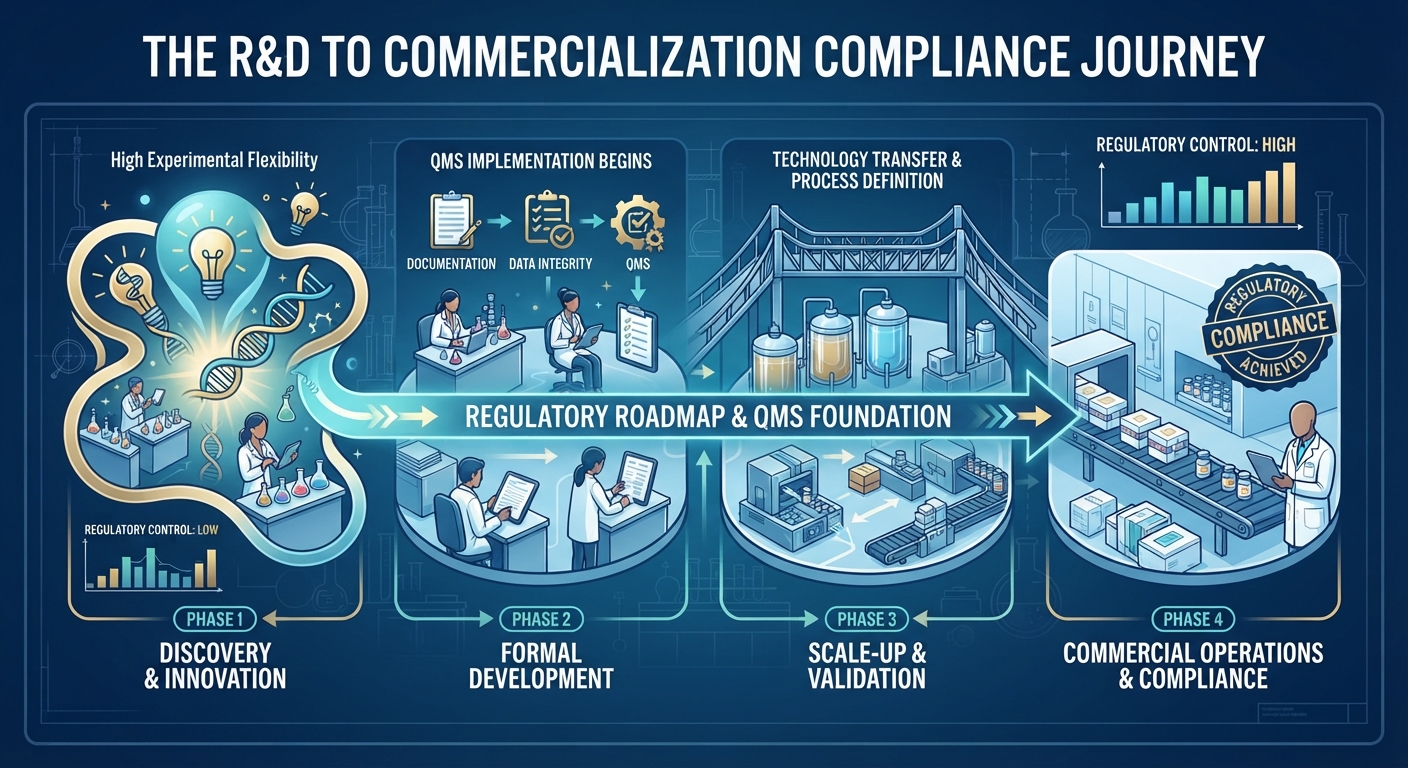
The transition from R&D to commercialization is a critical stage in the product life cycle. Research teams typically prioritise scientific discovery, experimental flexibility and the generation of new knowledge. Commercial operations require repeatable processes, controlled documentation, qualified equipment, trained personnel, reliable suppliers and systems that can demonstrate consistent performance over time.
These activities are not inherently separate. The challenge is to preserve scientific knowledge while progressively introducing the controls needed for regulated production, testing, distribution and post-market oversight.
For Australian organisations developing therapeutic goods, medical devices, biological products or laboratory services, early consideration of regulatory requirements can reduce the risk of expensive redevelopment, incomplete technical documentation and delayed market entry. A structured transition establishes the connection between development evidence, manufacturing processes, quality management and regulatory obligations before commercial commitments become difficult to change.
Understanding the Regulatory Requirements Early
Regulatory planning should begin during product development, when the intended purpose, product characteristics and anticipated markets are being defined. Waiting until a product is considered commercially ready can expose gaps in evidence that are difficult or expensive to address.
The applicable regulatory framework depends on the product category, intended use, manufacturing activities and jurisdiction. In Australia, the Therapeutic Goods Administration (TGA) regulates therapeutic goods under the relevant legislative framework. Different requirements apply to medicines, biologicals, medical devices and other regulated products.
Medicines may require evidence addressing quality, safety and efficacy, together with compliance with applicable manufacturing requirements. Medical devices are subject to requirements influenced by their classification, intended purpose and conformity assessment pathway. Biologicals have their own regulatory framework, including requirements relevant to product characteristics and manufacturing controls.
Organisations should identify which regulatory pathways apply, what evidence will be required and which parties hold specific regulatory responsibilities. These considerations should inform development plans, facility design, supplier selection and quality system implementation.
Regulatory requirements can also change as the product or business model evolves. A change in intended use, manufacturing location, formulation, device design or supply arrangement may affect the regulatory strategy. Defined change assessment processes help organisations identify these implications before implementing decisions that could compromise compliance.
Establishing Quality Systems During Development
A quality management system (QMS) provides the organisational framework for controlling activities that affect product quality and regulatory compliance. Its implementation should progress alongside research and development rather than being postponed until commercial manufacturing begins.
The appropriate system depends on the organisation's activities and applicable standards or regulatory requirements. ISO 13485 may be relevant to medical device manufacturers, while pharmaceutical manufacturing may be subject to applicable Good Manufacturing Practice (GMP) requirements. Testing laboratories may need to demonstrate conformity with relevant laboratory standards, including ISO/IEC 17025 where applicable.
Regardless of the framework, the system should define responsibilities, control documents and records, establish training requirements, manage suppliers, address nonconformities and support corrective action.
During early development, some processes may be exploratory. However, activities generating evidence for product safety, performance, quality or regulatory submissions require suitable controls. Organisations should define when experimental methods must be qualified, when equipment requires calibration or maintenance, and how data integrity will be maintained.
Introducing these controls progressively helps prevent a situation in which a company must reconstruct undocumented decisions or repeat studies because the original evidence cannot adequately support its intended use.
A well-designed QMS should reflect the organisation's current maturity while providing a practical path towards commercial readiness. It should be sufficiently robust to maintain control without imposing unnecessary administrative burdens on exploratory work.
Maintaining Data Integrity and Traceability
Development decisions depend on the quality and reliability of the underlying data. Experimental results, analytical measurements, process parameters and validation studies may become important evidence supporting product specifications, manufacturing instructions or regulatory submissions.
Data integrity requires information to remain accurate, complete, consistent and appropriately attributable throughout its life cycle. Controls should address how data are generated, reviewed, corrected, stored, transferred and retained.
Organisations should establish suitable access controls, audit trails where required, review procedures and record retention arrangements. Electronic systems used to generate or maintain regulated records may require validation or other documented assurance appropriate to their intended use and applicable requirements.
Traceability is equally important. A company should be able to connect relevant product requirements with development activities, testing results, risk assessments and approved specifications. For products involving complex manufacturing processes, this connection may extend to raw materials, suppliers, equipment, production batches and release decisions.
When data are generated by external laboratories or development partners, agreements and oversight arrangements should establish expectations for methods, records, deviations, reporting and access to supporting information.
Reliable traceability allows organisations to investigate unexpected results, understand the basis of technical decisions and demonstrate that the evidence supporting commercialisation is suitable for its intended purpose.
Transferring Processes into Commercial Manufacturing
Technology transfer converts development knowledge into processes that can be implemented consistently within a defined manufacturing environment. It requires more than transferring a written procedure or providing manufacturing staff with a set of instructions.
The receiving operation must understand the process, critical parameters, material requirements, equipment needs, acceptance criteria and known sources of variability. Development teams should communicate the scientific rationale behind important process decisions, including limitations identified during experimentation.
Manufacturing readiness assessments can identify gaps between the development environment and the proposed commercial process. Differences in equipment geometry, production scale, material characteristics, environmental conditions or operator practices may influence process performance.
For pharmaceutical and biotechnology products, scale-up can affect mixing, heat transfer, mass transfer, biological activity, impurity profiles and other quality attributes. For medical devices, changes in tooling, component suppliers, assembly methods or production conditions may affect performance and safety.
Process qualification and validation activities should be planned according to the applicable regulatory requirements and the nature of the process. Where validation is required, evidence should demonstrate that the defined process can achieve its intended outcomes under specified conditions.
Transfer activities should also address deviations, unresolved technical questions, training needs and ownership of process documentation. Clear acceptance criteria help determine whether the receiving site is prepared to operate the process and whether additional development or qualification work is necessary.
Managing Risk, Deviations and Change
Risk management provides a systematic method for identifying potential failures and determining the controls necessary to prevent or reduce unacceptable outcomes.
During development, risks may arise from product design, raw materials, analytical methods, process variability, equipment limitations or human factors. Commercialisation introduces additional considerations, including larger production volumes, supply continuity, distribution conditions and the consequences of recurring failures.
Risk assessments should inform decisions about testing, process controls, supplier qualification, validation and monitoring. Their conclusions should be documented and reviewed when new evidence becomes available.
Deviation management is another essential component of the transition. Unexpected experimental results, out-of-specification results, manufacturing failures and procedural departures should be assessed according to their significance and the applicable procedures.
Investigations should establish what happened, assess potential product and data impacts, and determine whether corrective or preventive measures are warranted. The depth of an investigation should reflect the issue's significance, recurrence and potential consequences.
Changes to formulations, specifications, analytical methods, equipment, software, suppliers or manufacturing processes should undergo documented evaluation before implementation. Depending on the change, additional testing, validation, stability assessment, risk review or regulatory action may be necessary.
A disciplined change management process allows organisations to continue improving their products and operations without losing control of the evidence supporting product quality and regulatory compliance.
Preparing Facilities, Equipment and Personnel
Commercial readiness depends on the suitability of the physical environment, equipment and workforce. Facilities and equipment must support the activities performed and meet applicable requirements for cleanliness, contamination control, environmental conditions, maintenance and monitoring.
Requirements vary significantly across product types. Sterile manufacturing, for example, involves specialised contamination control measures, while laboratory operations may require controls addressing sample integrity, environmental conditions and measurement reliability.
Equipment should be selected for its intended application and managed through appropriate installation, qualification, calibration, maintenance and operational procedures where required.
Personnel must have the education, training and practical competence necessary to perform assigned tasks. Training programmes should address applicable procedures, technical methods, documentation practices, safety considerations and escalation requirements.
Competency assessments can help establish whether training has achieved its intended outcome. Where critical activities depend on individual proficiency, organisations should define suitable authorisation and ongoing assessment arrangements.
Resource planning should also account for the additional responsibilities created by commercial operations, including quality assurance, regulatory affairs, supplier management, production planning and post-market monitoring.
Addressing these needs before commercial launch reduces the likelihood that essential controls will depend on informal practices or individuals whose knowledge has not been adequately transferred to the wider organisation.
Establishing Reliable Testing and Product Release
Commercialisation requires a clear framework for determining whether products meet their approved specifications and applicable release requirements.
Analytical methods developed during R&D may need additional evaluation to demonstrate suitability for their intended use. Depending on the method and product, this can include assessment of accuracy, precision, specificity, sensitivity, range, robustness and other relevant performance characteristics.
Method validation, verification or transfer requirements should be determined according to the applicable framework and the method's intended use. Not every method requires an identical set of studies, and the rationale for the selected approach should be documented.
Specifications should reflect relevant product quality attributes and be supported by appropriate scientific and technical evidence. Acceptance criteria should not be selected solely because they are easy to achieve during development.
Where testing is outsourced, organisations should establish suitable controls over laboratory competence, methods, sample handling, results reporting and investigation of unexpected findings.
Product release responsibilities must also be clearly assigned. The applicable requirements determine which checks, reviews, approvals and records must be completed before a product can be released or supplied.
Release decisions should rely on complete and reviewed evidence, not assumptions that a product is acceptable because previous development batches performed well.
Maintaining Compliance After Commercialisation
Commercial launch marks the beginning of routine operation, not the end of regulatory responsibility.
Organisations must maintain applicable quality systems, monitor product performance and respond appropriately to complaints, adverse events, nonconformities and emerging risks. Specific post-market obligations depend on the product category, jurisdiction and regulatory role of the organisation.
Manufacturing performance should be monitored to identify trends in deviations, rejected batches, process variability, supplier performance and other indicators relevant to product quality.
Complaint handling and post-market surveillance can generate information that challenges earlier assumptions or identifies previously unrecognised failure modes. This information should feed into risk management, product improvement and regulatory decision-making.
Periodic reviews of procedures, training, equipment, suppliers and process performance help ensure that controls remain suitable as production volumes and organisational complexity increase.
Internal audits and management reviews provide mechanisms for evaluating whether the system continues to operate as intended. Corrective actions should address significant problems and be evaluated for effectiveness where appropriate.
Maintaining compliance requires sustained ownership across the organisation. Quality and regulatory responsibilities cannot be confined to a single department when product decisions are made across research, engineering, manufacturing, testing and commercial operations.
Building an Effective R&D to Commercialisation Roadmap
A structured transition begins with an assessment of the product's development status, regulatory pathway, evidence base, manufacturing arrangements and quality system maturity.
The resulting roadmap should identify critical gaps, assign accountable owners and establish priorities based on regulatory requirements, product risks and commercial dependencies.
Early priorities may include defining the regulatory strategy, establishing document control, assessing data integrity and identifying the quality system requirements applicable to development activities. Later stages may focus on technology transfer, equipment qualification, method validation, process validation, supplier readiness and operational training.
Readiness reviews should use objective evidence to determine whether defined milestones have been achieved. Unresolved issues should be documented, evaluated and assigned appropriate actions rather than being carried forward without clear accountability.
External expertise can assist with regulatory interpretation, quality system design, validation planning and remediation of identified gaps. Effective support should also strengthen internal capability so that employees can maintain and improve the system after implementation.
Quality Systems Now supports organisations in developing practical quality and compliance arrangements that connect scientific development with regulated operations. The objective is to establish controls that meet applicable requirements, preserve reliable evidence and support consistent execution as products advance towards commercial supply.
Successful R&D to commercialization compliance depends on integrating regulatory planning, scientific evidence, process control and organisational capability throughout the product life cycle. When these elements develop together, companies are better positioned to manage technical uncertainty, demonstrate compliance and establish sustainable commercial operations.
