QUALITY MANAGEMENT SYSTEMS DESIGN & DEPLOYMENT FOR GMP & ISO COMPLIANCE
The QMS Problems We Solve
"Our QMS exists, but nobody actually follows it." Procedures written for auditors, not for the people executing them, get worked around rather than worked with — leaving you exposed to major findings the moment an auditor tests what actually happens on the floor.
"Everything is in someone's head, not in the system." When that person leaves, or an auditor asks for evidence, there's nothing written down to show — putting both continuity and compliance at serious risk.
"We're drowning in documentation that doesn't talk to itself." Duplication, contradictions and gaps between QMS, product development and training records are exactly what a trained auditor is looking for.
"Our procedures are technically correct but practically unreadable." Documents nobody understands don't just fail to train staff — they actively increase deviations and leave your team exposed under questioning during an inspection.
"We're starting completely from scratch and don't know where to begin." Without a structured starting point, early decisions get made ad hoc — creating rework, delays and compliance gaps that tend to surface later, often mid-audit.
"We don't know how to turn GMP and ISO requirements into an actual working system." Misapplying a requirement doesn't just risk a finding — it can delay your licensing, accreditation or product release altogether.
"Our processes are unique to us, and generic templates don't fit." Forcing your business into a generic template creates a mismatch between what's written and what's actually done — one of the most common root causes of audit findings.
"Our subject matter experts know the work, but not how to write an SOP." Procedures written without SME input get ignored on the floor — exactly the kind of gap inspectors are trained to probe.
Practical, Plain-Language QMS Design, Implementation and Improvement
A Quality Management System should make compliance easier — not add another layer of burden on top of it. Too often, we meet clients whose QMS is technically compliant on paper but practically unworkable in the day-to-day: procedures nobody reads, documents written in dense regulatory jargon, systems that were built for an audit rather than for the people who have to use them every day.
Our consultants have extensive industry experience designing, implementing, upgrading and training teams on every aspect of a QMS. Whether you need a documentation project as part of business as usual, or a full QMS built from the ground up for a commercialisation project or greenfield facility, we help you end up with a system that's practical, scalable, and genuinely demonstrates compliance — not one that's burdensome, not user-friendly, and quietly becomes a compliance liability of its own.
A QMS for Wherever You're Starting Form
We support three broad groups of clients, often at very different points in their journey:
Building from scratch — greenfield sites, startups and new ventures. If you're setting up a new manufacturing site or laboratory and working toward GMP licensing or ISO accreditation, your PQS/QMS needs to be built to support that outcome from day one. See our Site Licensing and Accreditation page for how QMS development fits into that broader framework. The QMS behind a world-first ISO13485 facility.
Preparing for clinical trials — R&D teams and sponsors. If you're a sponsor of a medicine or medical device moving from R&D into clinical trials, you need a phase-appropriate PQS or QMS — enough rigour to satisfy GxP and sponsor obligations, without over-building for where you actually are. See our Clinical Trial Readiness & Sponsor Compliance page for more. A right-sized PQS for a clinical biotech sponsor.
Already operating — established businesses in business as usual (BAU). If you already have a PQS/QMS but it's aged, overly complex, disconnected from how the business actually works, or simply due for a revamp, we help you update, simplify and re-align it — including documenting new manufacturing lines, equipment, departments or facilities as your business grows. A full PQS and eQMS transition for a cannabis manufacturer.
Wherever you're starting from, the goal is the same: a QMS that's the right size for your business today, and that scales with you.
Our QMS Services
QMS development and implementation — across all product types, regulations and industries
QMS update, revamp and simplification — for systems that have become overly complex, outdated, or disconnected from daily operations
Technical writing — clear, compliant procedures, work instructions, forms and registers and all other supporting documentation
Strategy and implementation management — from initial design through to go-live and into business as usual
SME and stakeholder management — coordinating subject matter experts across your business so the QMS reflects how work actually happens, not just how it's assumed to happen
Process design and redesign, and process mapping — so your procedures reflect your real workflow
Strategies and tools for improving quality culture — helping teams actually use and own their QMS, rather than treat it as a compliance checkbox
Procedural updates and training, including training needs analysis and competency matrices aligned to your QMS
If your QMS needs to move from paper-based to electronic (eQMS), we also support that transition — see our Biz Transformation & Regulatory Compliance page.
Industries We Support
Pharmaceutical - all medicine types including investigational medicines
Medical device - all device types and classes
Distribution and wholesaling
Compounding
Veterinary
Laboratory
Research & development
ISO 9001–certified businesses supporting the above industries
How We Work: The QSN Framework and Six Pillars of Implementation
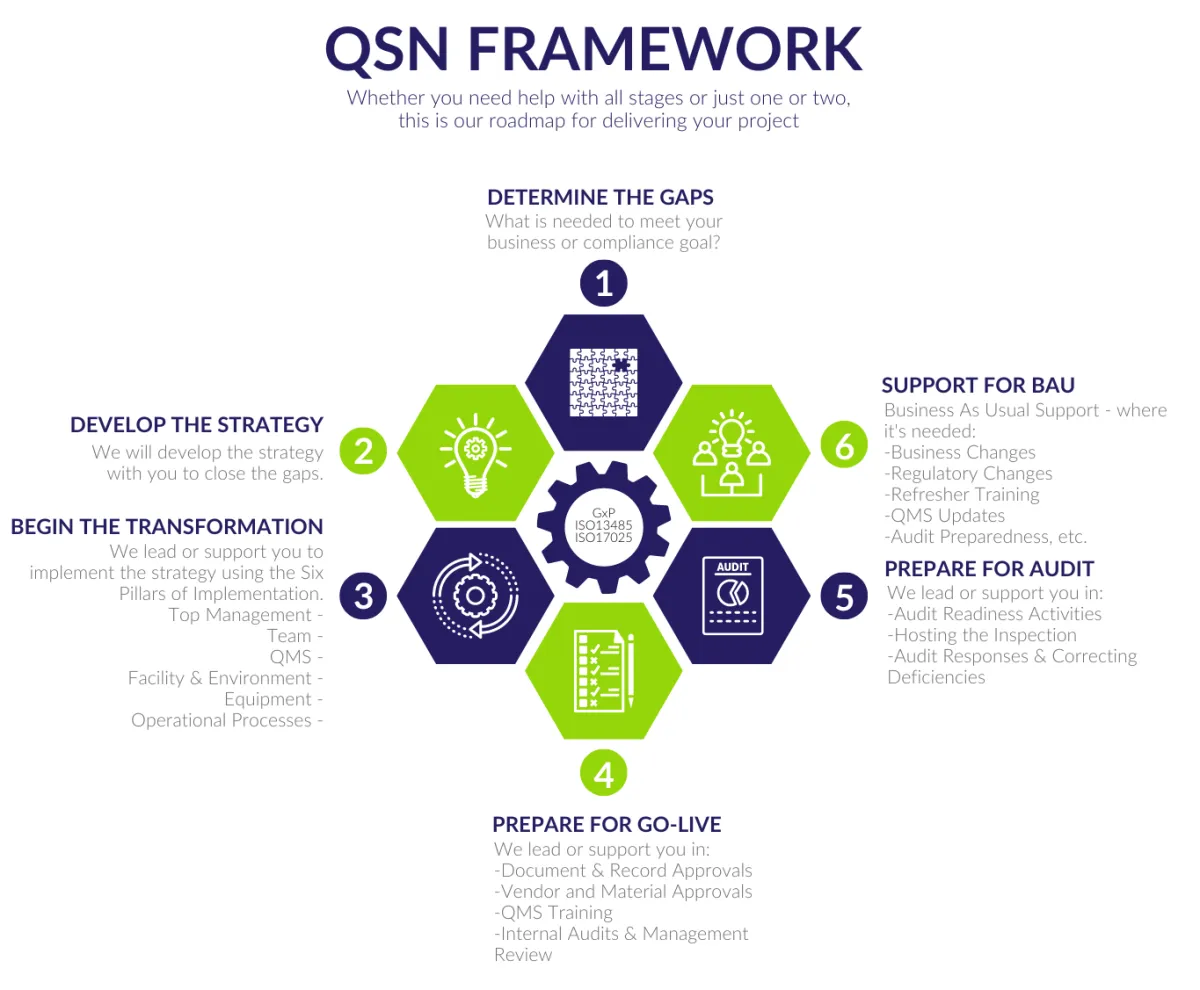
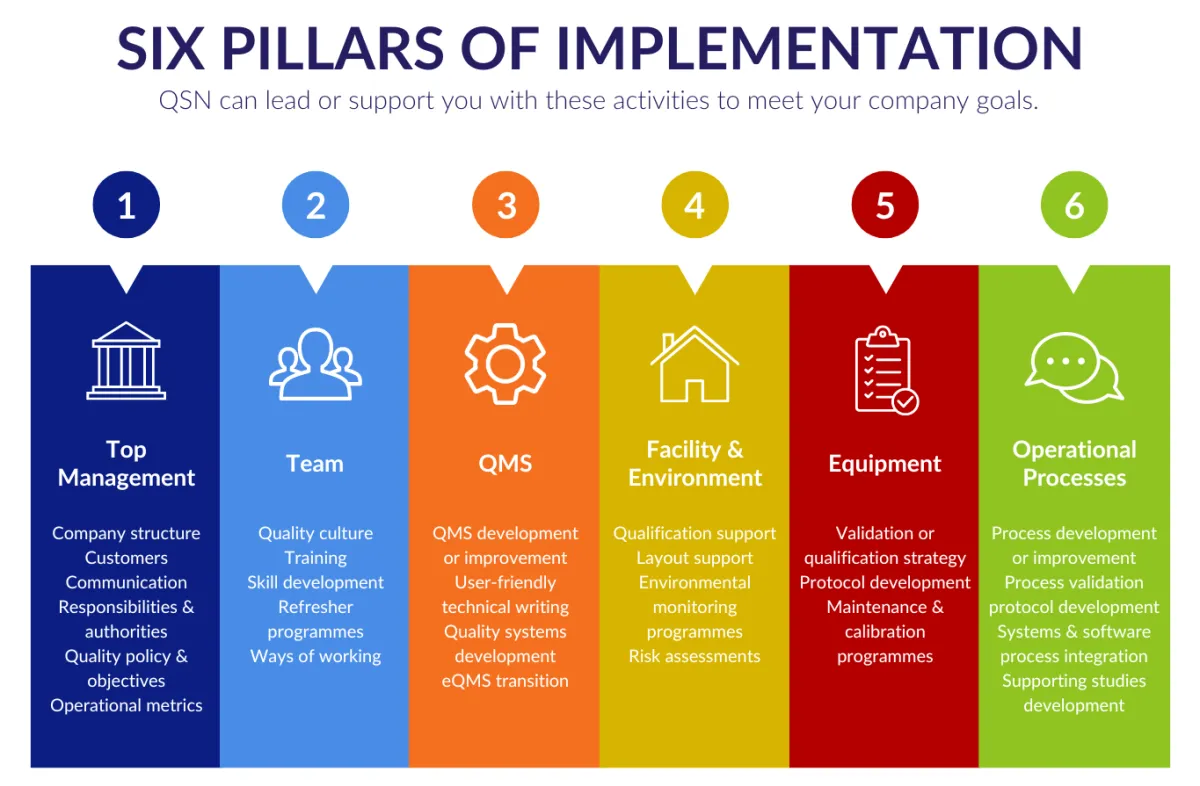
We apply the same structured approach to QMS projects that underpins all of our work — the QSN Framework, and the Six Pillars of Implementation. In practice, this means every QMS project starts by understanding where your systems, documentation and processes currently sit against what's required, then builds a resourced, staged plan to close the gap — rather than treating "build a QMS" as one undifferentiated task. That structure is what lets us scale a QMS project up or down depending on whether you're a five-person startup or an established multi-site manufacturer.
Why Work With QSN
Right-sized, not one-size-fits-all. We scope your QMS to your actual regulatory and business needs — not a template dropped in wholesale.
Built to be used, not just audited. Plain Language documentation means your team can actually follow, and be trained on, what you've built.
Cross-industry depth. Our consultants bring hands-on QA, QC, product development, validation, auditing and manufacturing experience across pharmaceutical, medical device, biotech, complementary medicine and medicinal cannabis clients.
We understand how systems connect. A QMS doesn't exist in isolation — we understand how it needs to work together with your product development, site licensing, training and audit readiness activities, so nothing is built in a silo.
We stay with you. QMS work doesn't stop at go-live — we support ongoing updates, technical writing and continuous improvement as your business and regulatory obligations evolve.
Frequently Asked Questions
Do we need a full PQS / QMS if we're still pre-clinical or clinical?
A mature pharma or medical device PQS/QMS is not needed but a phase-appropriate system will be needed that matches where your business is on the clinical development pathway.
Our QMS already exists - can you just fix specific problem areas?
Yes! Many of our client engagements are revamps, updates due to regulatory changes, or targeted documentation projects for businesses already in commercial operation, rather than a full rebuild.
What is Plain Language writing and why does it matters for a QMS
Plain Language means writing procedures and documents in clear, direct, jargon-minimal language that staff can genuinely understand and follow — rather than dense regulatory phrasing that technically satisfies an auditor but doesn't get used properly day-to-day. It reduces training time, reduces deviations caused by misunderstanding, and holds up better when staff are asked to explain their own procedures during an audit or inspection. Watch the free 'What is Plain Language' training.
Can you help us move from a paper-based QMS to an electronic one (eQMS)?
Yes, including User Requirement Specification (URS) development, software selection support, data cleansing and migration, validation, and training for go-live — see our Biz Transformation & Regulatory Compliance page for details.
Do you provide training as part of a QMS project?
Most definitely! Training delivery for QMS projects are typically built into our QMS engagements. We also offer many different standalone and Plain Language training through QSN Academy.
Ready to Build a QMS That Actually Works?
Whether you're starting from scratch, preparing for clinical trials, or improving a system you already have, we'll help you build a QMS that's right-sized for your business — and that your team will actually use.
Resources: QSN Academy · Blog · Webinars · eBooks · Scorecards · Book
Connect: LinkedIn (QSN) · LinkedIn (QSN Academy) · Linkedin (Dr Kathy Walsh) · Facebook · Email at info@qualitysystemsnow.com.au · Contact Us
Legal: Privacy Policy · Terms & Conditions · Complaints Procedure · Sitemap · QSN ABN 42 621 334 754