GMP SITE LICENSING & ISO13485, ISO17025 & ISO9001 ACCREDITATION
The Problem We See Most Often
Clients usually come to us at one of a few pain points:
"We don't know what we don't know." A greenfield site or a first-time sponsor doesn't yet have the internal expertise to know what a regulator or auditor will expect — and guessing wrong is expensive.
"We're already operating, but something's not sticking." An existing QMS exists on paper, but it isn't being used properly, isn't being kept current, or wasn't built with the end regulatory requirement in mind.
"We can't tell how long this will take or what it will cost." Without a clear framework, licensing and accreditation projects can drag on indefinitely, consuming budget with no visibility of the finish line.
"We're worried about the audit itself." Even businesses with a solid QMS can feel exposed when it comes to managing an inspector or auditor on-site, and responding to findings under pressure.
"Our team is stretched too thin to run this and keep the business going." Site licensing and accreditation projects are resource-intensive, and most teams are already at capacity delivering business as usual.
Want a clearer starting point? Our free GMP Licensing and ISO Accreditation Readiness Scorecard reveals the compliance gaps that typically emerge during licensing or accreditation inspections.
GMP Licensing and ISO Accreditation Consultants for Pharma, Medical Device, Biotech and Testing Labs
Getting a manufacturing site licensed or a laboratory accredited is one of the highest-stakes projects a therapeutic goods or testing business will run. It touches every part of the organisation — facilities, equipment, people, documentation, suppliers — and a misstep can mean a failed inspection, a delayed launch, or months of costly rework.
Quality Systems Now (QSN) helps pharmaceutical, medical device, biotech, medicinal cannabis and testing laboratory businesses gain, and then keep, their GMP licence or ISO accreditation. We work alongside your team as hands-on compliance partners — not just advisors who hand over a report and disappear.
Standards and Licences We Support
We routinely support clients through accreditation and licensing to:
Good Manufacturing Practice (GMP) — pharmaceutical, veterinary and medicinal cannabis manufacturing facilities (PIC/S, TGA, ODC, EU and FDA requirements)
ISO 13485 — medical device manufacturing, including in-vitro diagnostics (IVDs) and Software as a Medical Device (SaMD)
ISO 17025 — testing and calibration laboratories, particularly those supporting clinical trials or biotech
ISO 9001 — quality management systems for companies supporting the pharmaceutical, medical device and biotech industries
AS 4187 / AS 5369 — reprocessing of reusable medical devices
If your business doesn't fit neatly into one of these categories, get in touch anyway — it's very likely one of our consultants can still help.
The QSN Framework: How We Get You Licensed or Accredited
Every project is unique — not every client needs every stage, and some require additional activities beyond what's listed here — but the QSN Framework gives you a clear, staged roadmap from "where are we now" to "we're licensed/accredited and staying that way."
Stage 1 — Determine the Gaps
We review your existing QMS procedures, processes, systems and products against the relevant standard (and, where relevant, the regulatory market for your product). If you don't yet have a QMS in place, there's nothing to gap-analyse — every applicable requirement is simply in scope from day one, so we go straight to building it with you.
Stage 2 — Develop the Strategy
Using the QSN Framework and what's specifically required for your product, facility or device class, we work with you to build a practical, resourced strategy for reaching licensing or accreditation. Some device classes and facility types only need a lean QMS; others require the full weight of regulatory requirements — we scope this honestly up front so you're not over-building or under-building your system.
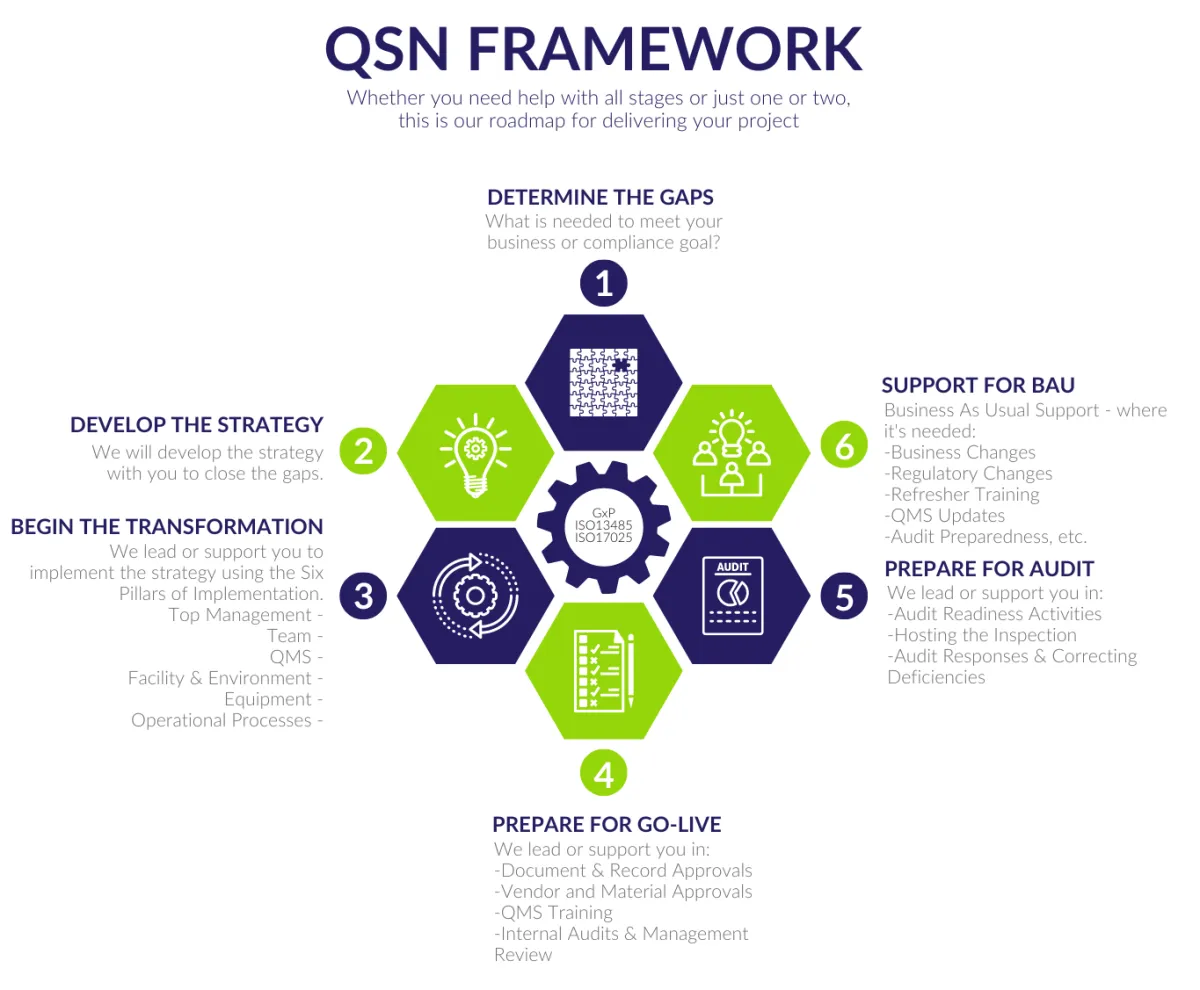
Stage 3 — Begin the Transformation
This is where the heavy lifting happens, and it's where greenfield sites, startups and new ventures typically need the most support. We develop or upgrade your core quality systems and QMS procedures, and build out client-specific systems and procedures covering areas such as:
Manufacturing and release for supply
Security and equipment
Specifications
Environment and facility
Material management
Product, design and development
We also plan and draft validation and qualification protocols, and support your team to execute and document them — for equipment, process, cleaning, computer systems (CSV), transport, temperature mapping and test methods.
Stage 4 — Prepare for Go-Live
We implement the documentation system end-to-end: document approvals, "read and understand" training for your people, publishing final QMS documents and locking down original versions. We help you complete vendor qualifications, run your first management review, complete internal audits, manage the transition through a go-live change control, and finalise any outstanding studies, design and development or clinical reporting needed to support product registration.
Stage 5 — Prepare for Audit
This is the stage that gives most clients the biggest confidence boost. We run a mock inspection against the relevant requirements (PIC/S GMP, ISO 13485, ISO 17025/15189, etc.), delivered by a QSN representative, complete with an audit report and a documented list of deficiencies. We then support you to close those deficiencies, and — critically — we're there with you during the actual inspection by the regulator or notified body, whether that's in a "war room" on-site or supporting remotely over video. If deficiencies are raised, we help you address them too.
Stage 6 — Support for Business As Usual
Getting licensed or accredited isn't the finish line — it's the start of an ongoing compliance obligation. We continue to support clients after go-live with business changes, regulatory updates, refresher training, QMS updates and technical writing, and audit preparedness for future surveillance or renewal audits — so you maintain best-in-class compliance rather than slipping back into non-conformance.
How Long Does It Take?
Timelines depend entirely on your starting point and the complexity of your product or facility:
Greenfield sites with no QMS in place typically take 9 to 12 months to reach licensing or accreditation, provided the project has consistent client engagement throughout.
Businesses already operating, with a reasonably robust QMS, product development and operations in place, can generally move through the process considerably faster.
Medicine and medical device sponsors typically need a new QMS and training in how to work with critical suppliers such as contract manufacturers, clinical research organisations and other vendors — this usually takes 3 to 6 months, depending on what else is running in parallel.
We can give you a realistic, specific timeline for your business once we've completed a gap analysis — no guesswork required.
Two greenfield projects, from start to accreditation/licensing:
What's Included Across a Site Licensing or Accreditation Project
Depending on your stage and standard, our support can include:
Strategy for GMP licensing / ISO accreditation
Support for validation and qualification
Environmental monitoring programs
Dress code and gowning requirements
Material, personnel and product movement studies
QA input on facility design reviews and facility layouts, against both the regulations and end-user needs
QMS development, go-live management and personnel training
Material qualifications and management
Supporting studies required for licensing or accreditation
Training and mentoring for your team
Audit readiness, on-site inspection support, and deficiency remediation
Why Work With QSN?
You keep ownership. We can provide day-to-day project direction or simply act as an extra set of expert hands — either way, your team owns the transition and builds real in-house knowledge of the standard, rather than becoming dependent on an outside consultant indefinitely.
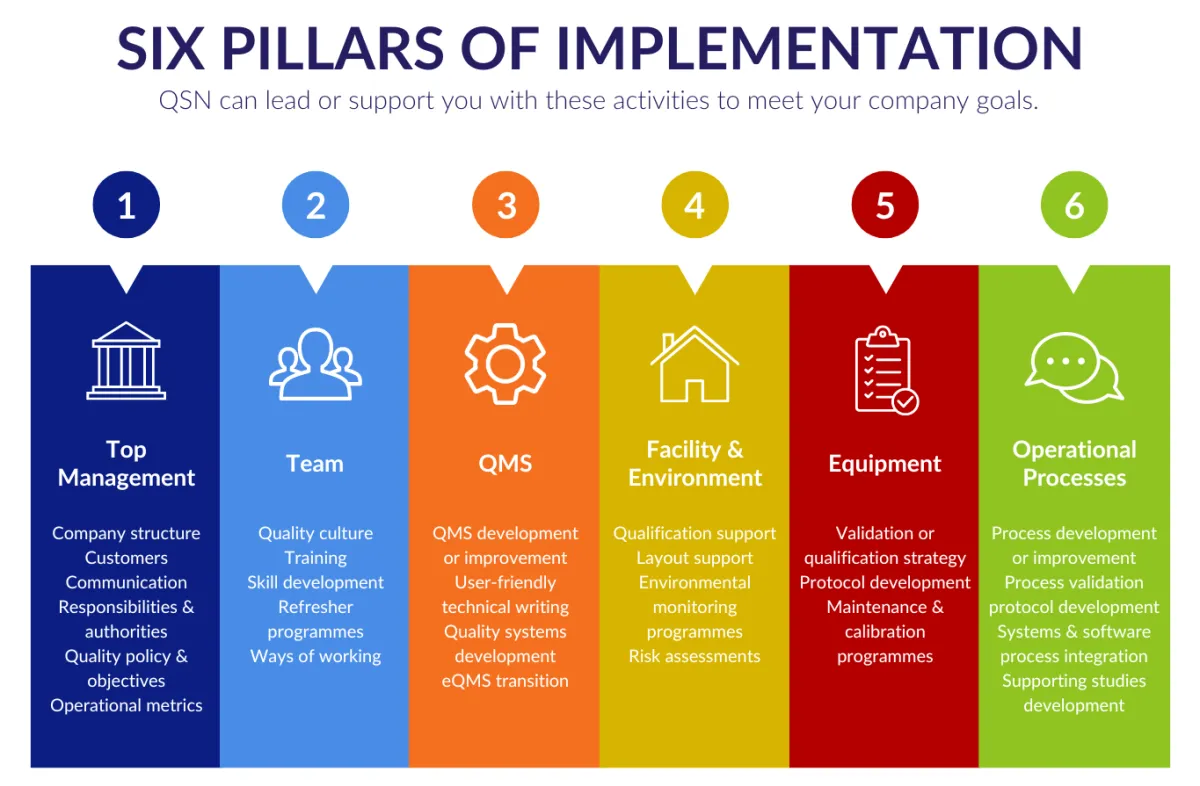
A named framework, not an open-ended engagement. The QSN Framework and Six Pillars of Implementation give every project a defined structure across all areas of development and change on your site, so you always know what stage you're at and what's next.
We understand your business risk, not just the standard. Before we start, we help you understand your compliance and accreditation responsibilities, the business risks involved, and realistic timelines and expenditure — so decisions are made with eyes open.
We stay with you past go-live. Licensing and accreditation are not one-off projects for us; we support clients through BAU, refresher training and future audits to help you stay best-in-class.
Broad, practical experience. Our consulting team has strong hands-on experience across QA, QC, product/design and development, R&D, validation, auditing, manufacturing and technical writing — across pharmaceutical, medical device, complementary medicine, biotechnology and medicinal cannabis clients, from startups through to large established manufacturers.
Frequently Asked Questions
Do we need a full QMS before we start a gap analysis? No. If you don't yet have an existing QMS, a gap analysis isn't required — every relevant requirement for your standard is simply in scope, and we build from there.
How is site licensing different from ISO accreditation? GMP licensing (for pharmaceutical, veterinary or medicinal cannabis manufacturing) is a regulatory licence granted by a government body such as the TGA or ODC. ISO accreditation (ISO 13485, ISO 17025, ISO 9001) is certification against an international standard, typically granted by a certification body or notified body. The QSN Framework's staged approach applies to both, though the specific requirements, audit bodies and terminology differ.
Can you help if we're already operating and just need to fix gaps? Yes. Many of our clients are already licensed or accredited, or already operating, and come to us for compliance or process improvements, additional validation, or further documentation of product development or design and development — rather than a full greenfield build.
What happens if we fail part of the inspection or audit? Our Stage 5 support includes assistance addressing inspection or audit deficiencies, and we can support you during the inspection itself. The mock audit we run beforehand is designed to surface likely findings while there's still time to fix them.
Do you provide training as part of this? Yes. Training is not mandatory but is strongly recommended at several stages, and is tailored to your starting position and compliance maturity. Courses are also available through QSN Academy.
Ready to Understand Your Path to Licensing or Accreditation?
Every business's starting point is different. The fastest way to get a realistic view of your timeline, cost and the specific gaps you need to close is a gap analysis with our team.
Resources: QSN Academy · Blog · Webinars · eBooks · Scorecards · Book
Connect: LinkedIn (QSN) · LinkedIn (QSN Academy) · Linkedin (Dr Kathy Walsh) · Facebook · Email at info@qualitysystemsnow.com.au · Contact Us
Legal: Privacy Policy · Terms & Conditions · Complaints Procedure · Sitemap · QSN ABN 42 621 334 754