CLINICAL TRIAL GMP READINESS & SPONSOR COMPLIANCE FOR PHARMA & MEDICAL DEVICE
The Challenges We Solve
Inadequate phase-appropriate compliance. Early-stage systems, built for speed in the lab, don't scale to what GxP (GLP, GCP, GMP) expects once you're producing clinical trial material or generating data for submission.
Limited understanding of sponsor responsibilities. Even when testing or manufacture is outsourced, the sponsor remains accountable for oversight, vendor qualification, stability and CMC, and the integrity of the resulting data.
Unverified processes and data integrity risks. Informal methods, undocumented deviations and incomplete validation threaten both product quality and your submission timelines.
Disconnected operations. Data, documentation and process control systems that evolved separately, in isolation from each other, create inefficiencies and compliance gaps right when you can least afford them.
Not knowing how much system is "enough." Overbuilding a full commercial-grade QMS at pre-clinical stage wastes runway; underbuilding it risks a failed audit, a clinical hold, or data that can't be relied on for submission.
Not sure if this is for you? Take our free Clinical Trial Sponsor Readiness Scorecard — a fast way to see where your gaps are before they become regulatory issues.
Helping R&D Teams Transition Towards Commercialisation with Confidence
Your science works. The question is whether your systems, documentation and data will hold up once you move from the lab bench to a clinical trial — and whether you, as sponsor, can demonstrate that to a regulator, an ethics committee, or a due-diligence partner.
Emerging R&D and startup companies often struggle to balance innovation with increasing compliance rigour. Laboratory methods, lab-scale batches and informal practices that worked well for early development don't automatically transition to clinical trial material and commercial manufacturing. Get the balance wrong, and you either over-build systems years before you need them, or under-prepare for the manufacturing, validation and licensing requirements a trial or submission demands. This is the phase-appropriate compliance journey with investigational medicines and medical devices.
QSN helps sponsors bridge that gap — turning scientific success into regulatory compliance success, at the level of rigour each stage actually requires.
Who Is This For?
We help sponsors of medicines and medical devices who have been through R&D and are preparing for, or entering, clinical trials — whether that's a first-in-human study, an early feasibility study, or a pivotal trial ahead of registration. That includes:
Pharma, biotech or medtech sponsors preparing an Investigational Medicinal Product (IMP) for a clinical trial
Medical device sponsors moving towards/through design verification and clinical validation ahead of a clinical investigation
Startups and spin-outs who have a product but don't yet have sponsor systems and compliance in place
Companies who have outsourced manufacturing or testing to a CRO or CMO, but do not have a credible QMS/PQS and still carry the regulatory accountability.
Why "Sponsor" Compliance?
Under GCP and the regulatory frameworks that govern clinical trials (including the Clinical Trial Notification and Clinical Trial Exemption schemes in Australia), the sponsor is the entity that takes responsibility for initiating, managing and financing a clinical trial — and that responsibility exists whether you run every activity in-house or outsource it entirely to contract manufacturers, testing labs and clinical research organisations. Regulators and auditors hold the sponsor accountable, not the vendor.
That's the gap we most often see: a company has excellent scientific data, but no formal sponsor-side quality system to demonstrate oversight of its suppliers, its investigational product, or its data integrity — and that becomes very visible, very quickly, once an inspection, audit or investor due-diligence process begins.
Phase-Appropriate Compliance, By Product Type
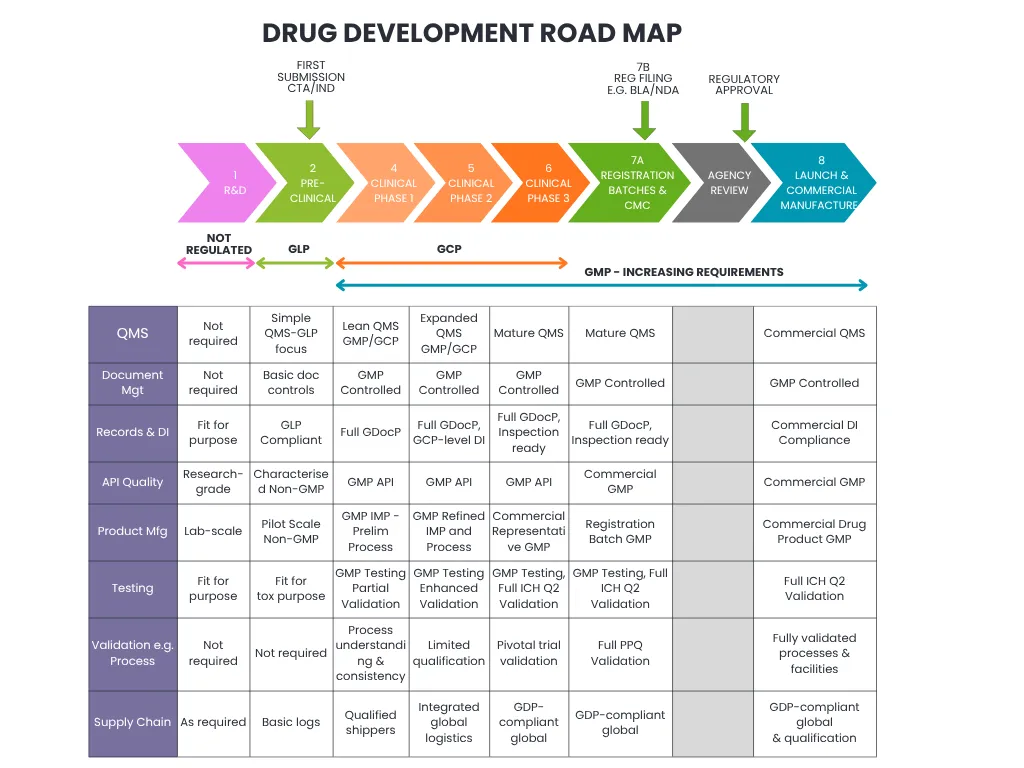
For Medicines and Biologics (GLP → GCP → GMP)
As you move from non-clinical work through to clinical trial material and eventual commercial manufacture, the level of compliance rigor required increases. We help you build only what's appropriate for where you are, including:
Process development, including identification of Critical Process Parameters (CPPs)
Stability strategy aligned to your regulatory aspirations, and design of stability programs
Specification development and management
Design of supporting studies required for registration — non-clinical (GLP), clinical (GCP), transport and cold-chain studies, extractables and leachables, container-closure studies, small-scale manufacturing batches, engineering batches, media fills and material testing
Technical transfer from development to clinical, and eventually commercial, manufacturing
Equipment, process, cleaning, computer systems (CSV), transport, temperature mapping and analytical/test method validation
For Medical Devices (Design Controls under ISO 13485)
Design and development of a device under ISO 13485 moves through defined stages — prototype, product verification, clinical validation, and transfer to commercial manufacturing — and each stage has different documentation and control expectations. We help you build a Quality Management System that matches the stage you're actually at, so design history and technical file evidence stands up to scrutiny later, rather than being reconstructed retrospectively under time pressure.
Our Approach: The QSN R&D Framework
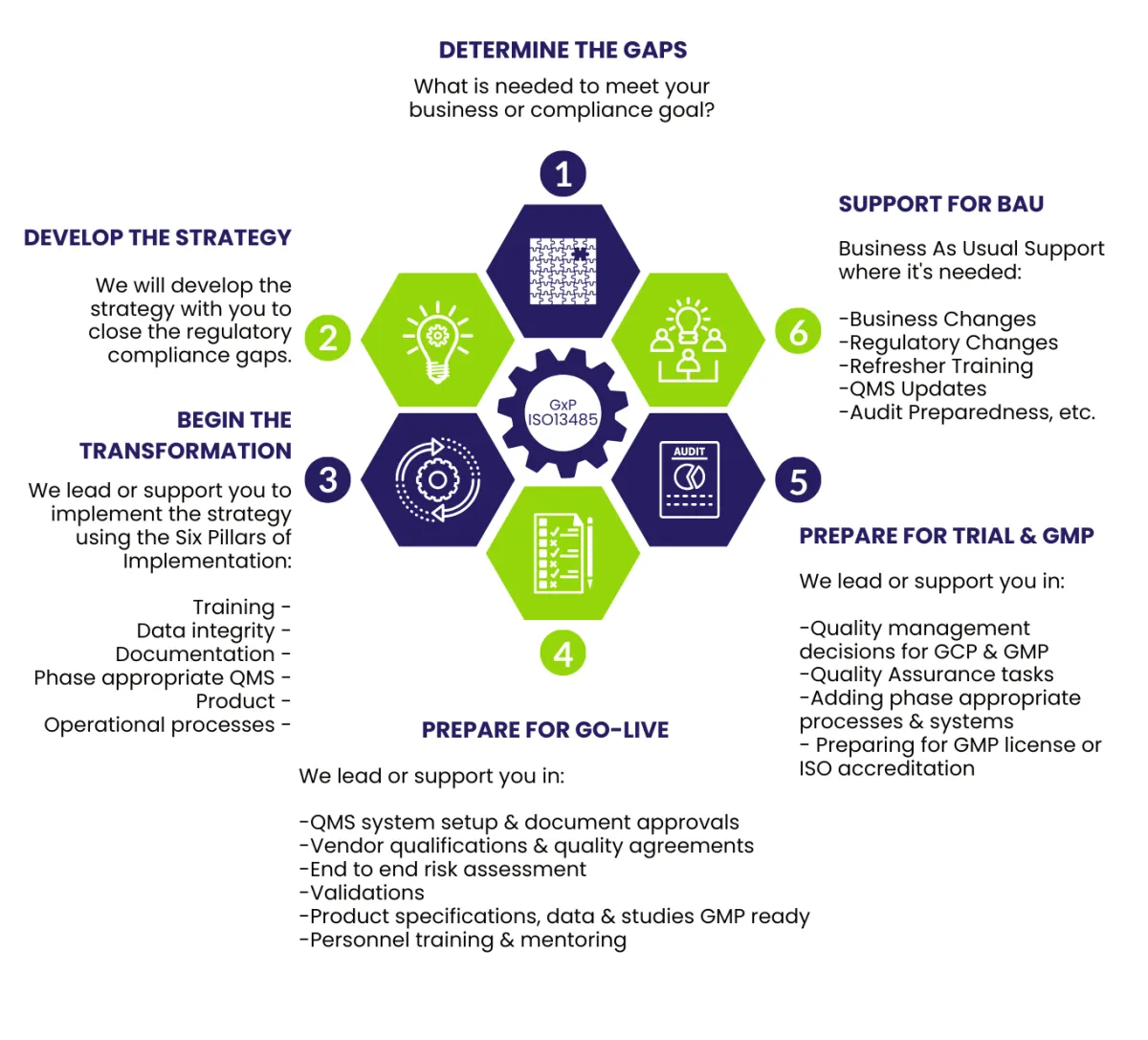
We guide you to establish compliance practices and rigour appropriate for each stage of product development, using our structured, end-to-end R&D Framework and the Six Pillars of Implementation for R&D — ensuring your product, compliance and operational systems start working together toward your clinical or phase-appropriate goals, rather than evolving as disconnected efforts. In practice, that means:
Understanding where you actually are — your current data package, systems and evidence, assessed against what your next milestone (trial submission, ethics approval, audit, or registration) actually requires.
Scoping only what's needed for that milestone — not a full commercial QMS on day one, and not a bare-minimum system that collapses under audit.
Building sponsor oversight into outsourced relationships — vendor qualification, quality agreements, and data integrity controls over CROs, CMOs and testing labs, so your accountability as sponsor is demonstrably discharged.
Preparing you for what comes next — so that today's clinical-stage PQS/QMS becomes tomorrow's foundation for GMP licensing or ISO 13485 accreditation, instead of being rebuilt from scratch.
What This Looks Like In Practice
A gap analysis of your current development data, processes and documentation against the requirements of your next stage (trial, submission, or audit)
A right-sized compliance roadmap — what to build now, what to defer, and why
Support drafting and executing validation and qualification protocols for the studies your trial or submission depends on
Vendor and supplier qualification support for CROs, CMOs and testing laboratories
Technical writing and documentation support so your design history file or development record can withstand scrutiny
Training and mentoring for your team as sponsor-side responsibilities increase
Why Work With QSN?
We speak both languages. Our team has hands-on experience in GxP - product/design and development, R&D, validation, auditing, quality systems, CMC and manufacturing — we understand the scientific side as well as the compliance side, and where the two need to meet.
Phase-appropriate, not one-size-fits-all. We won't sell you a full commercial QMS when you're still pre-clinical, and we won't let you walk into an inspection under-prepared either.
We understand sponsor accountability. Outsourcing manufacture or testing doesn't outsource responsibility — we help you build the oversight systems that prove you've discharged it.
A clear path to what's next. The systems we help you build at clinical trial stage are designed to extend into GMP licensing or ISO 13485 accreditation later, rather than being thrown away and rebuilt.
Broad industry experience. We've worked with manufacturers, sponsors, laboratories, pharmacies, startups and R&D teams across pharmaceutical, medical device, complementary medicine, biotechnology and medicinal cannabis, at every stage of their compliance and commercialisation journey.
Frequently Asked Questions
We've outsourced our manufacturing and testing — do we still need our own compliance systems? Yes. As sponsor, you remain accountable for the trial and the product, regardless of who performs the work. Regulators expect to see evidence of your oversight — vendor qualification, quality agreements, and controls over the data your vendors generate on your behalf.
How much PQS/QMS do we actually need before our clinical trial? It depends on your product, trial phase and regulatory pathway — but it's rarely "everything" and rarely "nothing." A short gap analysis against your specific next milestone gives you a precise answer, rather than a generic checklist.
We're a device company — how is this different from GMP for medicines? Medical devices follow design controls under ISO 13485 — prototype, verification, clinical validation, and transfer to manufacturing — rather than the GLP/GCP/GMP continuum used for medicines. The principle is the same (build only what the current stage requires), but the specific documentation and evidence expected differs.
Can you help us if we've never done this before? Yes — this is exactly where we spend most of our time. Many of the R&D teams and startups we work with are preparing for their first trial and submission, and don't yet have any sponsor PQS/QMS in place.
What happens after our trial — do you help with GMP licensing or ISO accreditation too? Yes. The systems we help you establish for clinical trial readiness are designed to extend into full GMP licensing or ISO 13485 accreditation when you're ready to scale to commercial manufacture — see our Site Licensing and Accreditation services.
Ready to Commercialize with Confidence?
Whether you’re scaling for clinical manufacture, preparing for GMP licensing, or transitioning to ISO 13485 accreditation — QSN helps you connect the dots between R&D, quality, and business performance. Book a call to assess your readiness and receive a tailored commercialization roadmap.
Resources: QSN Academy · Blog · Webinars · eBooks · Scorecards · Book
Connect: LinkedIn (QSN) · LinkedIn (QSN Academy) · Linkedin (Dr Kathy Walsh) · Facebook · Email at info@qualitysystemsnow.com.au · Contact Us
Legal: Privacy Policy · Terms & Conditions · Complaints Procedure · Sitemap · QSN ABN 42 621 334 754